
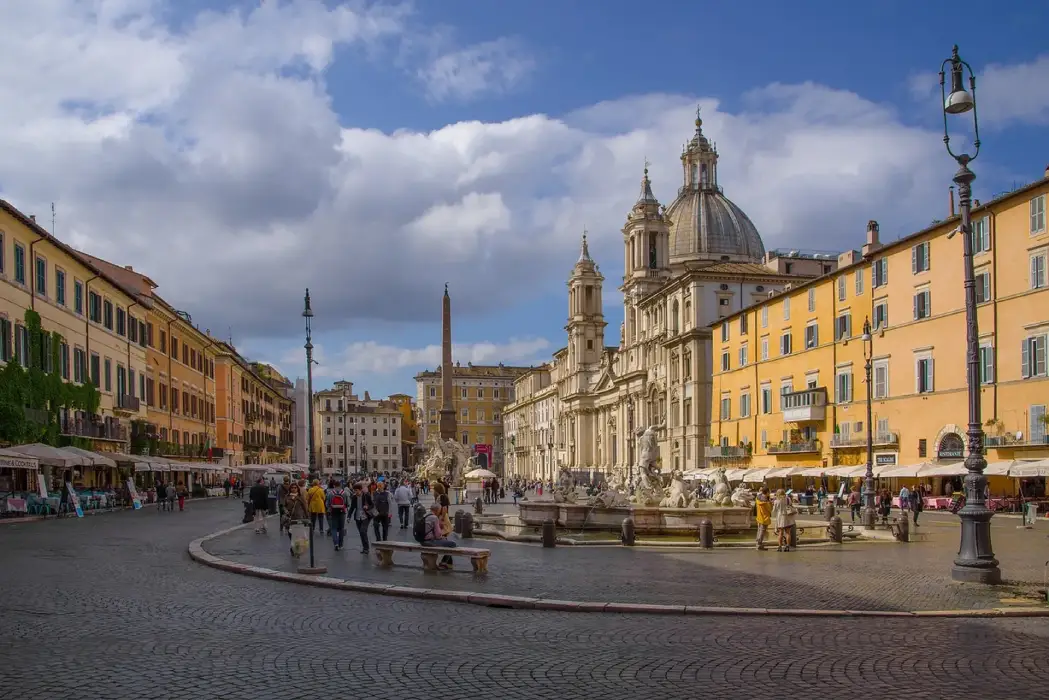
Piazza Navona: the vibrant heart of Rome
Introduction to Piazza Navona
Piazza Navona is considered one of the most beautiful and famous squares in Rome، Italy. This square is distinguished by its rich history and magnificent Baroque architecture, which makes it an indispensable tourist destination for every visitor to the Eternal City.
Located in the heart of the ancient city, Piazza Navona was built on the ruins of the Domitian Stadium, which dates back to the first century AD. The arena has retained its oval shape, which reflects the shape of the old stadium, which gives it a unique and distinctive character.
The fountain of the Great River: Bernini's masterpiece
- One of the most notable sights of Piazza Navona is the fountain of the Great River (Fontana dei Quattro Fiumi) designed by the famous Italian sculptor Gian Lorenzo Bernini in the XVII century. This fountain is considered a magnificent Baroque masterpiece, embodying four main rivers representing the four continents known at that time: the Nile (Africa), the Danube (Europe), the Ganges (Asia) and the Rio de la Plata (the Americas).
- Each of the characters of the rivers is distinguished by subtle details that reflect the nature of the continent it represents. For example, the statue of the Nile River is distinguished by covering its head, which indicates that its source was unknown at that time. As for the statue of the Ganges, it holds a paddle, symbolizing the ease of movement on it.
- In the middle of the fountain is an ancient Egyptian obelisk, which increases the grandeur and splendor of this historical landmark. The fountain of the Great River is the main attraction of Piazza Navona, where tourists gather to take pictures and admire its beauty.
Neptune fountain and the Muri fountain
- In addition to the fountain of the Great River, the Piazza Navona has two more magnificent fountains: the fountain of Neptune (Fontana del Nettuno) and the fountain of the Mori (Fontana del Moro).
- The fountain of Neptune, located at the northern end of the square, depicts the sea god Neptune wrestling with an octopus. This fountain was originally designed by Giacomo Della Porta in the XVI century, but sculptures depicting Neptune and an octopus were added later.
- The Mori fountain, located at the southern end of the square, depicts a mori (or African) figure wrestling a dolphin. This fountain was also designed by Giacomo Della Porta, but the central sculpture was added later by Bernini.
Churches and historical buildings surrounding the square
- Navona Square is surrounded by many magnificent historical churches and buildings. Among the most notable of these buildings is the Church of Sant'agnese in Agone (Chiesa di Sant'agnese in Agone), which is located on the western side of the square.
- The Church of St. Agnes in Agone is a great example of Baroque architecture, it was designed by Francesco Borromini and Carlo Rinaldi. The church is distinguished by its curved facade and magnificent dome, houses many paintings and sculptures of valuable art.
- In addition to the Church of St. Agnes, the Square is surrounded by several other historical palaces, such as the Pamphili Palace (Palazzo Pamphilj) and the Braschi Palace (Palazzo Braschi). These historical buildings reflect the grandeur and luxury of Rome of past eras.
Life in Piazza Navona: artists, restaurants and cafes
- Navona Square is a vibrant center, tourists and locals flock to it throughout the day. The Square is dotted with many restaurants and cafes serving the most delicious Italian dishes and refreshing drinks.
- The restaurants overlooking the Square have stunning views of the fountains and historical buildings, making it an ideal place to have a delicious meal and enjoy the charming atmosphere of Rome.
- Piazza Navona also has many artists and painters who exhibit their artwork along the Piazza. You can enjoy viewing various paintings and drawings, or even ask to draw a portrait of yourself as a beautiful memory of your visit to Rome.
- خلال فترة الأعياد والمناسبات الخاصة، تشهد ساحة نافونا العديد من الفعاليات والاحتفالات، مما يزيد من سحرها وجمالها.
Tips for visitors
- The best time to visit Piazza Navona is early in the morning or late in the evening, when the Square is less crowded.
- Don't forget to take a camera with you to take wonderful souvenir photos of fountains and historical buildings.
- Try eating delicious Italian ice cream in one of the cafes overlooking the square.
- Pay attention to your personal belongings, as there may be some pickpockets in crowded places.
- Enjoy the charming atmosphere of Rome and take your time to admire the beauty of Piazza Navona.
Conclusion
- Piazza Navona is a real gem in the heart of Rome, Combining history, art and culture in one place. Visiting this magnificent Square is an unforgettable experience, it will make you adore Rome and yearn to return to it again.